


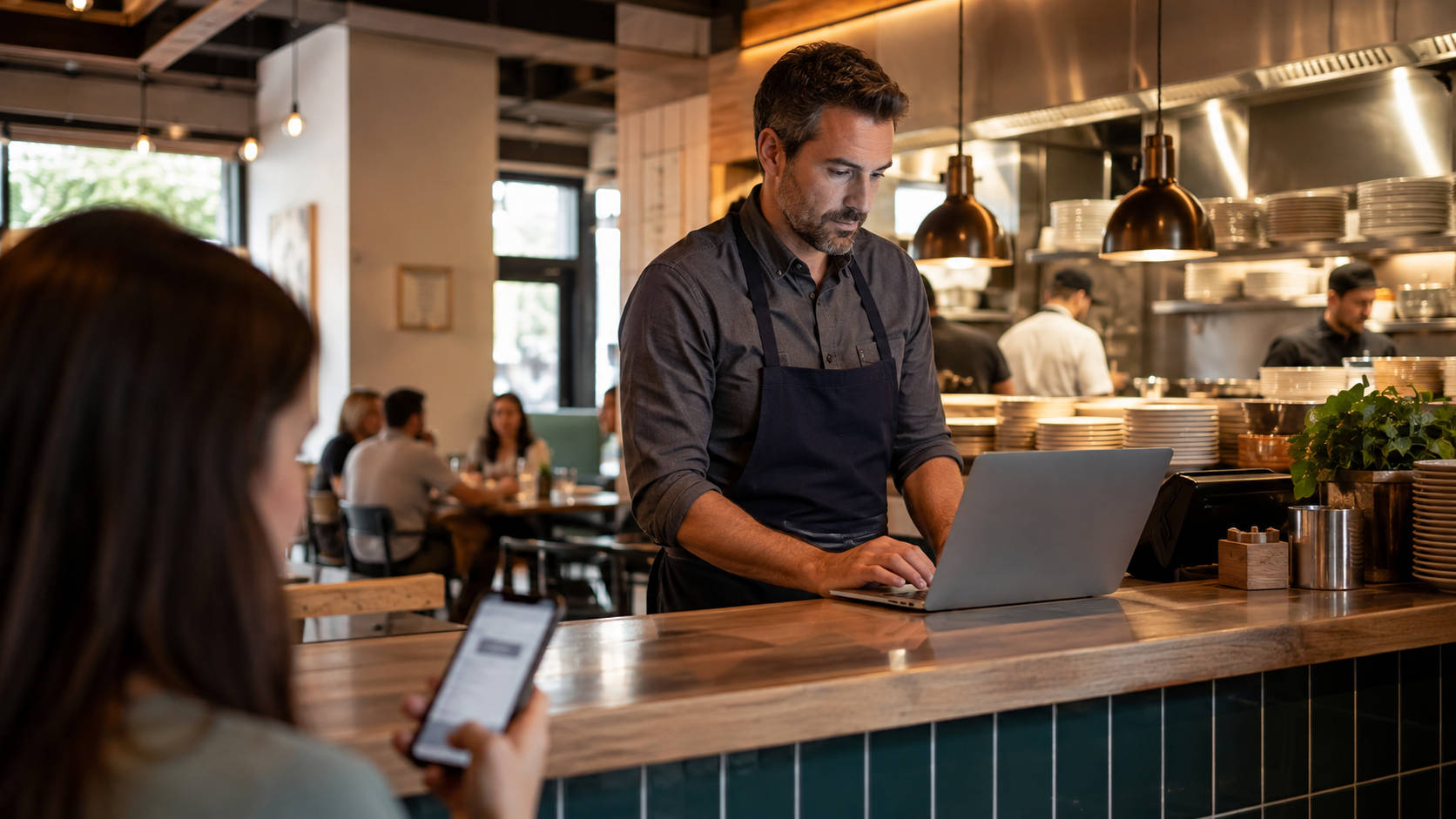
- What Is Restaurant AI Search Visibility?
- Why AI Restaurant Discovery Matters Now
- What a New Audit Found About Restaurant Recommendations
- Why Five Stars May Not Be Enough
- The Restaurant Recommendability Framework
- How to Improve Your Restaurant’s AI Search Visibility
- The Technology Lesson — Create One Source of Truth
- Conclusion
- Frequently Asked Questions About Restaurant AI Search
- More Helpful Reads
More diners are skipping the search bar and typing full requests into AI assistants. A sentence like this is now a normal way to look for dinner:
“Find a family-owned Mediterranean restaurant on my way home with vegetarian entrées under $20 and pickup available.”
That request asks an AI system to work out a lot at once: your location, the cuisine, whether the place is truly family-owned, whether it handles vegetarian orders, what dishes cost, whether it’s open, whether its menu is current, and whether you can place a pickup order. If the assistant can’t confirm those details for your restaurant, it usually moves on to one it can.
So here’s the honest answer up front: restaurants improve their chances of being recommended when their information is current, specific, machine-readable, and backed by more than one trustworthy source.
Key takeaways
- A high star rating may not be enough on its own to enter an AI-generated recommendation.
- An owned website, visible prices, review volume, and third-party mentions were each associated with inclusion in one recent audit.
- Accurate menu, listing, and ordering details work best when you treat them as one connected operational system, not separate marketing tasks.
What Is Restaurant AI Search Visibility?
Restaurant AI search visibility is the likelihood that an assistant such as ChatGPT, Gemini, or Google Maps can identify and recommend your restaurant for a specific request. It depends on whether the system can find current information about your restaurant, understand what you offer, verify those details, and connect the customer to an appropriate next step.
You’ll sometimes see this called generative engine optimization, or GEO — the practice of making your information easier for AI systems to find, understand, verify, and cite. Whatever you call it, the work is practical: keep the facts about your restaurant clear and consistent everywhere they appear, and make it easy for a customer to take the next step.
Why AI Restaurant Discovery Matters Now
AI restaurant discovery matters now because assistants are moving closer to the transaction, not just the suggestion.
In August 2026, Google announced that its Ask Maps feature can find a specific dish along your route, weigh details like dietary needs and saved places, point you to an open restaurant, and add the chosen dish to your cart. Google said food ordering is rolling out first with Square and Toast, with Uber Eats next.
Reporting also indicates Yelp is licensing its reviews, photos, ratings, and business information to OpenAI for use in ChatGPT responses, with Yelp branding sometimes appearing alongside. Yelp has launched its own AI assistant to move people from browsing toward booking and ordering. And OpenAI’s documentation notes ChatGPT may use your location to make nearby results more relevant.
A pattern appears. The customer journey is stretching from a single question into a chain of steps:
Question → recommendation → restaurant selection → menu item → reservation or order.
This doesn’t mean traditional Google Search, social media, or delivery marketplaces are going away. AI is becoming an additional discovery layer — one more place your restaurant needs to be understood clearly, alongside the channels you already manage.
What a New Audit Found About Restaurant Recommendations
A recent audit found that most restaurants in its sample were never recommended by any AI system tested. In an August 2026 study titled “Invisible to the Machine,” researcher Vladimir Pitenin of Norly Research examined 4,776 cafés, restaurants, and bars across two bounded markets — Canggu and Ubud, Bali. Over seven days under a preregistered protocol, it collected 2,208 search-grounded responses from ChatGPT, Claude, Gemini, and Perplexity across 96 persona-conditioned queries.
In this audit, 85.6% of the venues were never recommended by any of the four systems. Even among established venues with at least 50 ratings, 72.6% never appeared. The factors most associated with entering an answer were an owned website (the strongest association measured), review volume, listed prices, and third-party web mentions. Star rating, on its own, was not associated with getting into the answer — though among venues that were recommended, a higher rating was associated with appearing first. The systems also recommended permanently closed venues 93 times, while outright fabrication of a nonexistent business was rare, at 0.08% of mentions. Agreement across the four systems was low.
| Study finding | What restaurant operators can take from it |
| 85.6% of venues were never recommended | Inclusion was highly concentrated in this audit |
| An owned website showed the strongest positive association | A restaurant-controlled source of information may matter |
| Review volume was associated with inclusion | A broader body of customer evidence may help establish credibility |
| Listed prices were associated with inclusion | Specific menu information may help systems match detailed requests |
| Third-party web mentions were associated with inclusion | Independent corroboration may strengthen confidence |
| Star rating predicted first position only among surfaced venues | Reputation may matter more after a restaurant enters consideration |
| 93 closed venues were recommended | Stale information may be a greater practical risk than fabricated businesses |
Research limitation: This audit covered two restaurant markets in Bali. It should not be treated as a universal measurement of U.S. restaurant visibility, but it offers an unusually detailed look at how a restaurant’s information may affect whether AI systems recommend it.
Why Five Stars May Not Be Enough
Five stars may not be enough because AI recommendations appear to work in two stages, and reputation seems to matter most in the second one. First, the system needs enough information to include your restaurant at all. Then, once you’re in the running, signals like your rating may help decide where you land.
Consider two restaurants. Restaurant A has a 4.8 rating but no proper website, no visible prices, an outdated menu, and few independent mentions. Restaurant B has a 4.5 rating, a current website, detailed menu descriptions with prices, active reviews, consistent listings, and a bit of local press.
Thr second restaurant won’t automatically win — nothing guarantees that. But it gives an AI system far more to evaluate, and more to explain, when deciding whether to recommend a place for a specific request.
Here’s the distinction: a rating answers “Do people like this restaurant?” It doesn’t always answer “Is this the right restaurant for this request?” Reviews may help a restaurant earn trust, but documentation may help it enter the conversation. That reading comes from one audit, but it’s a useful way to decide where to spend your time.
The Restaurant Recommendability Framework
Here’s a simple way to think about it. We call it the Restaurant Recommendability Framework — an Orders.co editorial framework created for this article, not an academic term or a proven ranking formula. Use it as a checklist for your own visibility.
We define restaurant recommendability as the degree to which an AI system can find, understand, verify, match, and help a customer act on your restaurant’s information. Those five verbs are the five parts.
1. Findability
Can the AI system access a reliable source about your restaurant?
Start with an owned website whose pages can actually be read, plus correct location pages, a complete Google Business Profile, a Yelp profile, and a few credible third-party mentions. For ChatGPT Search, OpenAI states that a website must allow its crawler, OAI-Searchbot, to be eligible for inclusion. That doesn’t guarantee a citation, but blocking it removes the chance.
2. Understandability
Can the system tell exactly what you offer?
That means cuisine type, signature dishes, a current menu with prices, dietary information, portion sizes, modifiers, and your service options — pickup, delivery, dine-in, catering, reservations — plus neighborhood and service area. Restaurant structured data helps search engines read these details (more below).
Keep your primary menu as accessible, text-based web content. A PDF or menu photo can be a secondary format, but the important facts shouldn’t live only inside an image, not because AI can’t read images, but because clean text is easier to access and keep accurate.
3. Verifiability
Do multiple credible sources agree on your details?
An assistant grows more confident when your name, address, phone, hours, menu, prices, cuisine, ordering links, and open-or-closed status line up across your website, Google Business Profile, Yelp, reservation and ordering pages, delivery listings, and any local coverage.
Consistency doesn’t mean pasting an identical paragraph everywhere. It means the underlying facts agree. Conflicting hours, or three different prices for one dish, give a system reasons to hesitate.
4. Matchability
Does your information explain when and why someone should choose you?
Diner prompts carry context: date night, family dinner, a quiet work lunch, a group celebration, a gluten-free meal, affordable pickup, late-night food, office catering, a regional specialty. Your website and profiles should describe the genuine occasions and needs you serve.
Describe what’s true. Keyword stuffing, or claiming needs you can’t actually meet, tends to create bad experiences and unhappy reviews.
5. Actionability
Can the diner act on the recommendation?
This is the last step: a working reservation link, a current direct ordering link, a mobile-friendly menu, accurate pickup and delivery options, visible hours, a clear location, obvious ordering buttons, a supported booking provider, and the correct menu source. OpenAI notes reservation availability appears in ChatGPT only when a supported provider has that restaurant’s information, and Google’s Ask Maps flow depends on the ordering path actually working.
A recommendation is far more valuable when the customer can finish the next step without friction.
How to Improve Your Restaurant’s AI Search Visibility
You improve your restaurant’s AI search visibility by fixing the information you control first, then adding technical clarity and outside evidence — in that order. Here’s a prioritized plan, not a generic checklist.
Step 1: Test what AI currently says. Run realistic prompts through ChatGPT, Gemini, Perplexity, Claude, and Google Maps. Try formats like:
- “Best [cuisine] restaurant in [neighborhood] for [occasion]”
- “Where can I get [signature dish] under [$ amount] near [landmark]?”
- “[Dietary need] restaurant near me that is open now”
- “Is [restaurant name] good for [occasion]?”
- “Can I order directly from [restaurant name]?”
For each, note whether your restaurant appears, which competitors appear, which sources are cited, and whether the cuisine, prices, hours, menu, and ordering or reservation path are correct. Expect results to vary between systems and even between repeated tries.
Step 2: Fix the restaurant-controlled information first. In priority order: your website, menu, hours, location information, direct ordering link, Google Business Profile, Yelp, and your reservation and delivery profiles. These are the sources you can change today.
Step 3: Add technical clarity. Allow OAI-Searchbot in your robots file. Use Restaurant or LocalBusiness structured data where appropriate, including menu URL, cuisine, price range, address, telephone, and hours. For this kind of blog article, use BlogPosting or Article structured data plus BreadcrumbList, keep the page indexable and fast on mobile, set accurate datePublished and dateModified values, and use a canonical URL. No single change guarantees a ranking improvement, but together these make your information easier to read.
Step 4: Build genuine outside evidence. Encourage honest reviews and respond to them, pursue local press and food-blog mentions, get into neighborhood guides, and use chamber, community, or cuisine-specific pages where they fit. Never buy reviews, write reviews for customers, gate reviews behind a rating filter, fake local press, or mass-produce low-quality listings. Those tactics tend to backfire and can violate platform rules.
The Technology Lesson — Create One Source of Truth
Here’s the part many owners miss: a lot of AI visibility problems are really operations problems. A restaurant often has one menu on its website, another on Google, different prices on delivery apps, old hours on Yelp, a disconnected ordering page, and sold-out dishes still showing online. Staff update one channel and forget the rest.
That’s not only an SEO issue — it’s an information-control issue. Before your restaurant’s information can be optimized, it has to be controlled.
This is where centralized restaurant technology helps. Orders.co brings restaurant websites, direct online ordering, menu management, guest feedback, reporting, and order integrations into a more centralized ecosystem. That doesn’t guarantee placement in any AI recommendation, and it doesn’t push your data into ChatGPT, Gemini, or Google. What it can do is make it easier to control and maintain the information customers — and machines — encounter across your connected channels.
The goal is simple: fewer places where your facts can drift out of sync.
See how Orders.co helps restaurants keep menus, ordering, and day-to-day operations connected.
Conclusion
You can’t control exactly what an AI assistant says about your restaurant. You can control whether the information available about your business is current, complete, specific, and easy to verify.
That’s the point. The goal isn’t to game AI or chase an algorithm — it’s to make your restaurant easier for both customers and technology to understand, which is good for the people walking through your door, too. Traditional local SEO still matters; this just adds a new reason to keep your basic facts in order. Start with one prompt, one profile, one menu, and work outward.
Frequently Asked Questions About Restaurant AI Search
There’s no guaranteed method or submission process. To improve your chances, make your website accessible to OAI-Searchbot and publish current menu details, prices, hours, cuisine, location, and ordering options. Keep your profiles consistent across Google, Yelp, and delivery apps, gather authentic reviews and credible third-party mentions, and test your restaurant against specific occasion-based prompts. ChatGPT has no single published ranking formula.
Common causes include missing or outdated information, a website the system can’t reach, no visible prices, inconsistent listings, few reviews, or limited independent mentions. Sometimes it’s simply weak alignment with the exact query someone typed. AI systems also give different answers to the same question, so absence from one test doesn’t prove permanent invisibility. Try several engines and prompts.
A website isn’t required for every AI answer, but it helps. In the August 2026 audit, having an owned website was positively associated with being included. A restaurant-controlled website gives you one reliable place for current menus, prices, hours, ordering links, cuisine, and location, and to update them when things change. This was an association, not proof of causation.
Reviews can contribute evidence about popularity, food quality, atmosphere, and the occasions a restaurant suits. In the August 2026 audit, review volume was associated with being included, while star rating was associated with appearing first only among restaurants already recommended. Yelp now provides information and reviews that may be used in ChatGPT responses. Google reviews don’t directly control ChatGPT’s rankings.
They overlap, but they aren’t identical. Local SEO builds the foundation — your website, profiles, reviews, and general authority. AI search visibility adds emphasis on answer-friendly content, specific menu facts, consistent details across sources, crawler access, and testing conversational prompts. Don’t abandon SEO for AI optimization; the strongest approach supports both, because they share many of the same signals.
Search several AI tools using cuisine, neighborhood, occasion, price, dietary, and dish-specific prompts. For each answer, record whether your restaurant appears and which sources are cited, then verify the menu, prices, hours, cuisine, and ordering path shown. Because results vary, repeat each prompt a few times rather than trusting one result, and recheck after major updates and at least monthly.


