


- Workplace Catering Is Becoming More Than the Occasional Office Lunch
- The Office Cafeteria Is No Longer the Only Way Companies Feed Employees
- One Catering Order Can Put Your Restaurant in Front of Dozens of New Diners
- Introducing the Catering Multiplier
- Corporate Catering Can Create Two Different Customers
- How Restaurants Can Turn Workplace Exposure Into Future Customers
- Measure More Than Catering Revenue
- Marketplace Catering and Direct Catering Can Play Different Roles
- Catering Growth Falls Apart If the Restaurant Cannot Operationally Handle It
- Where Orders.co Fits
- Frequently Asked Questions
- More Helpful Reads
Most restaurants judge a catering order by one number: the size of the check. A $700 office lunch shows up on the books as a $700 sale, gets filed next to a busy Saturday dinner, and the story ends there.
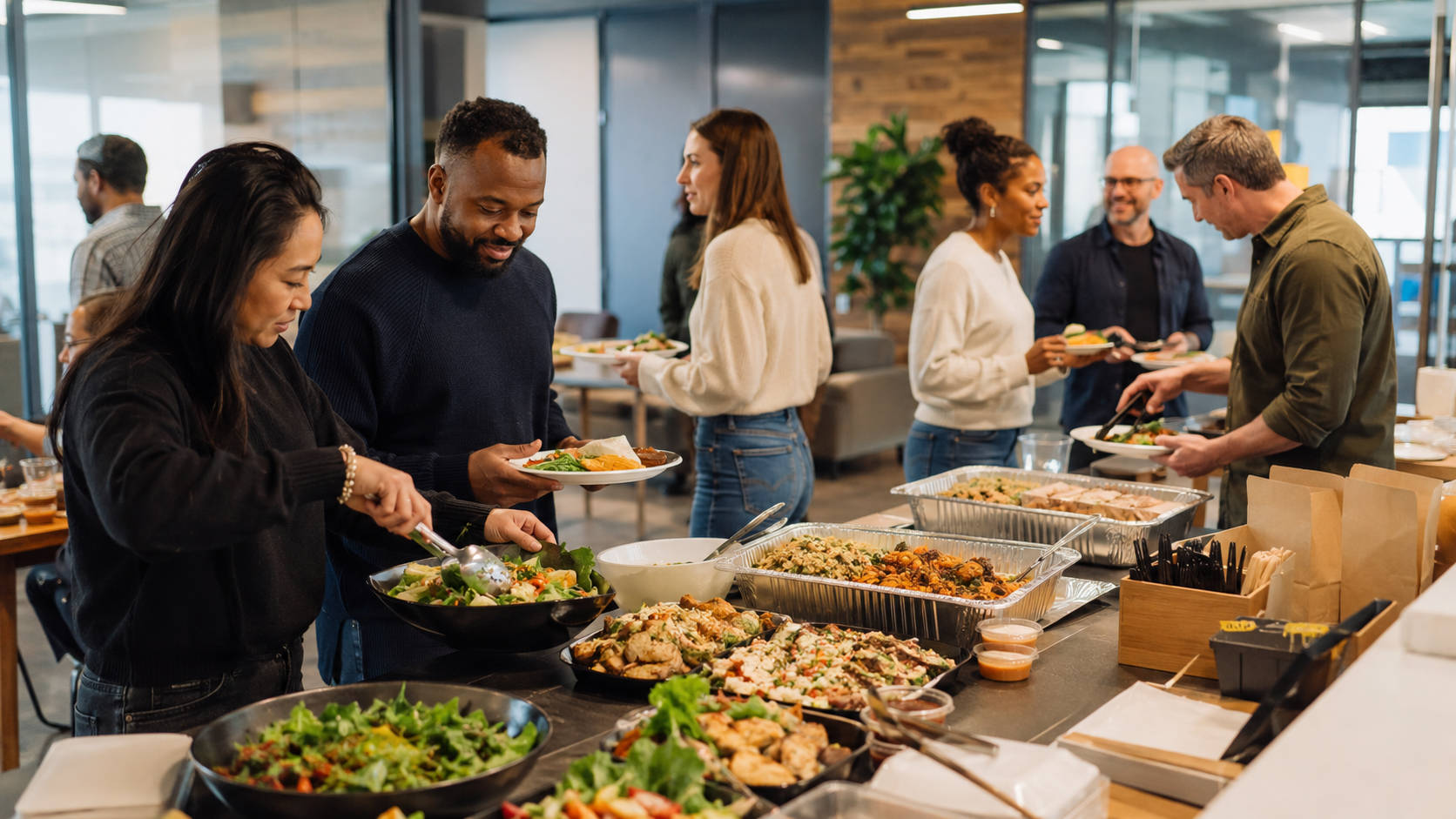
That same order may be doing something the P&L never records. If 35 people in that office are tasting your food for the first time, the check is only part of what the order is worth. You did not just sell lunch. You introduced your restaurant to 35 people who now know it exists.
New 2026 research from the catering platform ezCater puts numbers behind that idea, suggesting workplace catering behaves less like a one-time large transaction and more like discovery at scale. The case here is simple: workplace catering deserves to be evaluated as both a sales channel and a customer-acquisition channel, not just a bigger ticket.
Is workplace catering a good customer-acquisition channel for restaurants?
Yes, workplace catering can put a restaurant’s food in front of dozens of people through a single order. In ezCater’s 2026 workplace catering research, 62% of employees who first tried a restaurant through their workplace later ordered from it in their personal lives, and 67% recommended it to others. That is not a guaranteed conversion rate for every restaurant, but it suggests a catering order can create value well beyond its invoice.
Workplace Catering Is Becoming More Than the Occasional Office Lunch
For a long time, catering meant a few predictable events: a board meeting, the holiday party, the occasional conference tray. Those still happen. What is changing is how often food shows up at work for ordinary reasons.
According to ezCater’s 2026 research, 91% of workplace orderers planned to spend the same amount or more on food in 2026, and roughly one in five expected to increase spending by more than 25%. Daily or weekly workplace meal programs grew 26% year over year.
Frequency is the part that matters for a restaurant. A holiday party is one impression a year. Recurring team lunches, weekly return-to-office spreads, standing training-day orders, and client meetings are repeated impressions with the same group of people, not one visit a quarter.
The Office Cafeteria Is No Longer the Only Way Companies Feed Employees
Some of that new demand comes from a quieter shift inside larger workplaces: the traditional company cafeteria is getting harder to justify.
ezCater’s 2026 Workplace Cafeteria Report, which surveyed 602 cafeteria decision-makers and 1,000 onsite employees, found that 51% of decision-makers said cafeteria usage no longer justified its operating costs, and 55% expected those costs to rise in 2026. Among leaders at hybrid companies, 68% said fluctuating in-office headcounts make cafeterias difficult to run. Meanwhile, 76% of employees said restaurant food tastes better than cafeteria food, and 70% of leaders said they would like to supplement cafeterias with delivery from local restaurants.
None of this means cafeterias are disappearing. The grounded reading is that some employers want flexible, restaurant-powered options: supplementing a cafeteria, replacing one in certain workplaces, or feeding offices that never had one. That is a demand that used to stay inside the building.
One Catering Order Can Put Your Restaurant in Front of Dozens of New Diners
The center of the argument rests on three figures from ezCater’s 2026 workplace catering research: 96% of workplaces surveyed tried a restaurant that was new to them in 2025; 62% of employees who first encountered a restaurant through their workplace later ordered from it personally; and 67% recommended it to friends or family.
Food is an unusual kind of marketing because of the order in which things happen. Most restaurant marketing has to move a stranger through a sequence: see the restaurant, get interested, take a risk, place an order, and finally taste the food. Workplace catering can flip that sequence. The employer orders, the employee eats, the employee discovers the brand, and only then might that employee become a customer.
The employee never had to take the first risk. Their workplace made the introduction, and the food did the persuading. That makes catering a little like product sampling or word-of-mouth, with one important difference: with free sampling, you pay to give food away, while with catering, the restaurant is paid for the original food. The exposure comes attached to revenue, not instead of it.
Put plainly, workplace catering differs from most restaurant marketing because people can experience the food before they ever choose the restaurant themselves. Just don’t mistake it for free marketing; it still carries real acquisition and fulfillment costs.
Introducing the Catering Multiplier
If one order can generate revenue and exposure at once, valuing catering purely as revenue misses most of the picture. What follows is a decision framework, not an accounting formula, for what a catering order is actually worth. Call it the Catering Multiplier.
| Value created by a workplace catering order | Example |
| Immediate revenue | The catering order itself |
| Account value | Future orders from the same company |
| Employee exposure | People are trying the restaurant for the first time |
| Personal orders | Employees later order on their own |
| Word of mouth | Employees recommending the restaurant |
| Internal referrals | Another team or department ordering |
The multiplier is a way to think directionally, not a metric you reconcile to the penny. A restaurant that tracks only catering revenue sees the first row and ignores the rest, because the lower rows are hard to measure. That is exactly why catering gets undervalued.
Consider a local Mediterranean spot that caters lunch for 40 people at a nearby company. Those 40 people have now eaten the food, seen the name, maybe talked about the meal, and learned the restaurant exists. If even a fraction later search for it, order dinner, mention it at home, or suggest it for the next meeting, the commercial impact runs past the original receipt. That downstream effect is difficult to measure precisely, which is exactly why restaurants tend to ignore it.
Corporate Catering Can Create Two Different Customers
Once you see catering as acquisition, a second distinction appears. Every workplace catering order involves two different customers who want different things.
The buyer
The buyer places the order: an office manager, an executive assistant, an HR coordinator, an operations lead. This person cares about reliability, easy ordering, dietary options, delivery timing, clean invoicing, and consistency they can count on. They are judging whether ordering from you is a headache.
The eater
The eater is the employee with the plate. They care about taste, presentation, portion size, discovering something they like, and whether they would order it again on their own. They are judging the food.
A restaurant can win one and lose the other: you can impress the buyer with painless ordering and still serve food nobody remembers, or win over the eaters while making the buyer’s life so difficult they never order again. A catering program that grows has to satisfy both the person who signs off and the roomful of people who eat.
How Restaurants Can Turn Workplace Exposure Into Future Customers
Exposure only turns into business if people can act on it. A few practical, honest ways to help employees remember and find you after the meal:
Make the restaurant identifiable. People cannot become customers if they cannot remember who made the food. Packaging, labels, and printed materials should make the name obvious.
Get the experience right. The most effective catering marketing is still an accurate order, good presentation, correct dietary selections, on-time delivery, and food that travels well.
Be easy to find later. Some employees will look you up. Keep your Google Business Profile accurate, your website current, your menu easy to find, and your restaurant’s direct online ordering working on a phone.
Add a tasteful direct-order touchpoint. A branded box, a small card, a QR code, or a discreet first-order offer gives interested people a next step. Keep it light; catering trays should not look like advertisements.
Give people a reason to come back. Where you have permission, a loyalty signup or a first-order offer can help. Be precise about consent: do not assume you can market to employees whose contact information you never collected.
Keep the buyer coming back, too. The corporate account has its own lifetime value. Track the organization, the contact, order frequency, average spend, dietary preferences, past menus, and delivery notes so the next order is easier than the last.
Measure More Than Catering Revenue
If catering is an acquisition, catering revenue alone is an incomplete scorecard. A small restaurant does not need a data team, just a couple of extra things to watch.
Core catering metrics worth tracking: catering revenue, average catering order value, repeat catering rate, orders per corporate account, catering contribution margin, average lead time, order accuracy, and on-time delivery rate.
Acquisition indicators, wherever you can capture them: first-time website traffic after a large catering order, QR scans from catering materials, first direct orders placed with a catering-specific code, loyalty signups tied to catering, and referrals from corporate clients.
Attribution will never be clean, and chasing perfection is a waste of time. The goal is not to prove that Employee #23 ordered dinner two weeks later. It is to learn whether workplace catering consistently creates measurable activity beyond the original invoice. If it does, catering has earned a bigger place in your plans.
Marketplace Catering and Direct Catering Can Play Different Roles
Once catering works, a common question follows: Should orders come through a marketplace like ezCater or through your own channels? They do different jobs.
Catering marketplaces help restaurants get discovered. They put you in front of workplace buyers who are already looking, bring in new orders, and handle much of the work of finding clients.
Direct catering helps you deepen relationships you already have. Orders come through your own site, repeat corporate accounts build over time, and you keep more control over the experience.
Most restaurants do not have to pick one. Marketplaces can be useful for discovery, while direct channels become more valuable once a restaurant has awareness and repeat demand. Use a marketplace to be found and your own channels to keep the customers who found you, within each platform’s terms.
Catering Growth Falls Apart If the Restaurant Cannot Operationally Handle It
There is a catch. More catering is only good news if the kitchen can deliver it reliably. A catering order is a different animal from a lunch-rush ticket. It can involve a future date, large quantities, special pricing, dietary requirements, multiple packages, a headcount that changes twice before the event, a delivery window, a payment link or deposit, last-minute edits, and driver coordination, often all on one order. Handling that well is a big part of launching a restaurant catering program without disrupting the line.
Here is what makes operations a growth issue and not just logistics: customer acquisition without the capacity to fulfill it can damage the very reputation you are trying to build. If 50 employees meet your restaurant through a late or incorrect order, catering multiplies a bad first impression just as efficiently as a good one. The upside and the downside scale together.
Where Orders.co Fits
If catering becomes a real growth channel, it needs its own workflow, not the same path as a $15 takeout order.
Orders.co brings a restaurant’s orders into one system, and several of its capabilities apply directly to catering. It consolidates orders from DoorDash, Uber Eats, Grubhub, and ezCater, the catering marketplace many workplace buyers already use, into a single screen.
It also supports direct online ordering through the restaurant’s own site, along with menu management, customer information and order history, loyalty and marketing tools, its Delivery Dispatch System for fulfillment, and reporting.
Together, those pieces let a restaurant treat a catering order as a distinct kind of order: capturing the account, keeping the history, and coordinating delivery in the same place as the rest of its restaurant technology stack.
Frequently Asked Questions
There is no universal lead time. Each restaurant sets its own cutoff based on order size and kitchen capacity. Major catering programs show how wide the range runs: Chick-fil-A says all locations accept orders at least 24 hours ahead, while CAVA lets customers order months in advance. Larger or highly customized events generally need more notice. For an operator, the practical move is to publish your rules clearly: minimum lead time, different rules for very large orders, holiday deadlines, and the cutoff for changes. A stated policy prevents most last-minute problems.
Usually, yes. A minimum protects your economics, because catering carries costs that a normal order does not: extra prep, packaging, coordination, delivery, and administrative time. The right threshold is not a number you copy from another restaurant. It is the order size at which your catering workflow stays profitable after those added costs. Calculate the point where the work is worth it for your concept and fulfillment model, then set the minimum there.
Catering pricing should account for more than the standard menu price. Depending on how you fulfill orders, the real cost can include food, packaging, labor, delivery, setup, disposables, special staffing, and platform fees, plus the margin you want to keep. There is no single markup that works for every restaurant. The safer approach is to build pricing up from your actual costs rather than discounting your regular menu and hoping volume covers the difference. A dedicated catering-pricing guide is worth reading before you set your rates.
Corporate catering is relationship-driven, so the best sources are often close to home. Potential channels include your existing restaurant customers, local office managers and executive assistants, HR and workplace teams, local business groups, Google search, a dedicated catering landing page, corporate catering marketplaces, and referrals from clients you already serve. One repeat corporate account is usually worth more than a stream of one-off leads, so it pays to keep the clients you win rather than constantly chasing new ones.
A good catering menu makes ordering easy for a group. That means clearly showing serving sizes or headcounts, package options, dietary information, whether items come individually packaged or in trays, beverages, desserts, add-ons, lead times, minimums, and delivery or pickup options. ezCater reported in 2026 that restaurants with more detailed, descriptive menus on its platform received twice as many bookings, which is a useful direction, though that figure is ezCater platform data rather than proof that menu detail alone causes more orders everywhere.


