


- What Is a Ghost Kitchen?
- What Is a Q-Commerce Restaurant?
- Ghost Kitchen vs. Q-Commerce Restaurant: Simple Comparison
- Where Virtual Brands Fit In
- Can a Restaurant Be Both a Ghost Kitchen and a Q-Commerce Restaurant?
- The Real Difference Is Operational Design
- Why These Models Often Fail
- What Technology Does a Ghost Kitchen or Q-Commerce Restaurant Need?
- How Orders.co Fits Into Delivery-First Restaurant Models
- Which Model Makes More Sense for Your Restaurant?
- The Model Matters, But the System Matters More
- Frequently Asked Questions
A restaurant owner decides they want to launch a delivery-first concept. Maybe it’s a side brand, maybe it’s a whole new business. Within a week of researching, they’ve heard five different terms thrown around:
- Ghost kitchen
- Cloud kitchen
- Dark kitchen
- Virtual brand
- Q-commerce restaurant
Every vendor, consultant, and LinkedIn post makes each one sound like the next big opportunity. The labels start to blur together, and it’s easy to feel like you’re already behind.
But the real question is simpler than the vocabulary makes it seem:
Are you trying to reduce real estate costs, test a new brand, or build a fast delivery operation that can actually make money?
That’s the difference. And it comes down to one core distinction:
A ghost kitchen is where the food is made. A q-commerce restaurant is about how fast food is sold, prepared, fulfilled, and delivered.
One is a real estate and operating decision. The other is an operating-system decision. Once you see them that way, the rest of the noise gets a lot quieter.
What Is a Ghost Kitchen?
A ghost kitchen is a food business that prepares meals without a traditional dining room. Customers place orders online, and food goes out through third-party delivery apps, direct ordering, or pickup. No servers, no front-of-house, no tables.
The same idea shows up under a few names. “Cloud kitchen” and “dark kitchen” usually mean the same thing as ghost kitchen. They’re marketing labels for the same delivery-only model.
A ghost kitchen can take several forms:
- A standalone delivery-only kitchen
- A shared kitchen facility rented by the hour or month
- A commissary kitchen producing for multiple operators
- A kitchen running inside an existing restaurant’s downtime
- A multi-brand kitchen producing several concepts at once
Here’s the key point: a ghost kitchen is mainly a real estate and operating model. It answers one question: Where is the food being made?
Most ghost kitchens are small. In practice, they often operate 50 to 250 square feet of production space and rely heavily on marketplaces like Uber Eats and DoorDash for customer acquisition. They became popular after COVID-19, when off-premise dining surged, and operators looked for cheaper ways to test demand.
Practical example: An owner rents a small commercial kitchen in a warehouse district and sells burgers, wings, and rice bowls entirely through delivery apps. No storefront, no dining room, no servers. That’s a ghost kitchen.
The benefits are real. A typical full-service U.S. restaurant needs roughly $60,000 to $100,000 in monthly sales to be profitable. A lean ghost kitchen can reach break-even at $30,000 to $60,000 because it pays lower rent and far fewer employees. You also get:
- Lower front-of-house labor
- A smaller real estate footprint
- Easier, cheaper menu testing
- Lower startup cost than a full dine-in build-out
- The ability to run multiple brands from one space
The risks are just as real:
- Heavy dependence on delivery apps for visibility
- Packaging costs that eat into every order
- Marketplace commissions, often 15% to 30%
- Limited brand visibility with no street presence
- Harder to achieve customer loyalty and repeat business
- No walk-in traffic to fall back on
- A tougher time building customer trust
A ghost kitchen lowers your overhead. It does not, on its own, solve how you’ll get and keep customers.
What Is a Q-Commerce Restaurant?
A q-commerce restaurant (short for quick commerce) is a concept built around rapid digital ordering, fast preparation, fast hand-off, and fast delivery.
It may operate out of a ghost kitchen, but it doesn’t have to. The defining trait isn’t the location. It’s speed and fulfillment.
A q-commerce restaurant is designed around:
- Fast prep times
- A compact, focused menu
- A tight delivery radius
- Strong, travel-ready packaging
- High-frequency, repeat demand
- Easy reordering
- Visibility on delivery apps
- Direct online ordering
- Impulse and habit-driven purchases
The core point is that Q-commerce is mainly a speed-and-fulfillment model. It answers a different question: How quickly can this order be sold, prepared, handed off, and delivered?
Practical example: A bowl concept offers 12 core items, all built to assemble in minutes, packaged to survive the trip, and delivered within a tight local radius. Orders come from DoorDash, Uber Eats, the restaurant’s own ordering website, and SMS promotions to past customers. That’s q-commerce thinking.
The benefits:
- High order frequency
- A natural fit for delivery
- Easier repeat ordering and habit-building
- A focused menu that’s simpler to run
- A faster, more predictable kitchen workflow
- Real potential for direct customer retention
The risks:
- Constant speed pressure
- Smaller average tickets
- High operational intensity, especially at peak
- More room for mistakes during the rush
- Late orders that drag down your marketplace ranking
- Margins that vanish if delivery fees and packaging aren’t controlled
Speed wins customers. But speed without margin control just helps you lose money faster.
Ghost Kitchen vs. Q-Commerce Restaurant: Simple Comparison
| Category | Ghost Kitchen | Q-Commerce Restaurant |
| Main focus | A lower-cost, delivery-only kitchen | Fast digital ordering and fulfillment |
| Core question | Where is the food made? | How fast can the order move? |
| Dining room | Usually none | Usually none or limited dine-in |
| Menu strategy | Can be broad or multi-brand | Compact and speed-focused |
| Delivery radius | Depends on kitchen location and apps | Tight and intentional |
| Customer behavior | Delivery-focused | Convenience, impulse, and repeat ordering |
| Primary risk | Marketplace dependence | Speed without margin control |
| Best fit | Testing concepts, cutting overhead | High-frequency, fast-prep meals |
| Technology needs | Order and menu management | Full order routing, real-time menus, and reporting |
| Growth strategy | Add brands or locations cheaply | Build repeat orders and direct customers |
The takeaway: these aren’t competing choices on the same axis. One describes your real estate. The other describes your operating speed.
Where Virtual Brands Fit In
This is where most owners get confused, because virtual brands overlap with both models.
A virtual brand is an online-only restaurant brand that operates from an existing kitchen.
Example: A pizza shop launches a separate late-night wings brand from the same kitchen, using the same staff and equipment during slow hours. New brand, same building.
That alone does not make the pizza shop a ghost kitchen. If the original restaurant still has a storefront with dine-in or pickup, it’s a regular restaurant running a virtual brand on the side. The distinctions stack like this:
- A virtual brand can run from a ghost kitchen
- A virtual brand can run from an existing restaurant
- A ghost kitchen can run one brand or many
- A q-commerce restaurant can also run multiple virtual brands, but only if the systems are organized
A word of caution, because this is where operators get burned: launching more brands does not automatically mean more profit. It often means more menus, more tablets, more reporting headaches, more inventory confusion, and more mistakes. One real case from a few years back had a single operator juggling five concepts across 18 to 20 tablets. The result wasn’t more revenue. It was chaos, missed orders, and items that stayed “available” online long after they sold out.
Delivery platforms have also gotten stricter. Since 2023, Uber Eats and DoorDash have required virtual brand menus to be meaningfully distinct from the primary location’s menu, often differing by 70% to 80%. So you need real differentiation, not the same menu under a new logo.
Can a Restaurant Be Both a Ghost Kitchen and a Q-Commerce Restaurant?
Yes. The models overlap freely. Three quick examples show how:
Ghost kitchen but not q-commerce. A delivery-only premium pasta concept with long prep times, custom plating, and high-end packaging. No dining room, so it’s a ghost kitchen. But it isn’t built for fast, repeat, convenience-driven orders, so it isn’t really q-commerce.
Q-commerce, but not a ghost kitchen. A small storefront selling fast bowls, dumplings, sandwiches, or smoothies with rapid pickup and delivery. It has a physical location, so it’s not a pure ghost kitchen. But the menu and workflow are built for fast digital orders, so it operates with q-commerce thinking.
Both. A delivery-only kitchen serving high-frequency, fast-prep meals within a tight radius. No dining room and built for speed. That’s a ghost kitchen and a q-commerce restaurant all in one.
The Real Difference Is Operational Design
Here’s the part most “open a ghost kitchen!” pitches skip.
You shouldn’t choose a model because it sounds trendy. You should choose it based on operational questions you can answer honestly:
- What food actually travels well?
- What can my kitchen make quickly and consistently?
- Which items have genuinely strong margins?
- What packaging does each item require, and what does it cost?
- What delivery radius can we realistically serve fast?
- Which delivery channels bring profitable customers, not just orders?
- How will we get repeat customers to order directly from us?
- Can my staff manage every order from one place?
- Can I track profit by brand, by item, and by channel?
- Can I update menus everywhere without wasting an hour each time?
Opening a ghost kitchen is not a strategy. It’s a location decision. Building a q-commerce restaurant is not just about speed. It’s an operating-system decision.
Why These Models Often Fail
When ghost kitchens and q-commerce restaurants struggle, the same culprits show up over and over:
- Too much dependence on DoorDash, Uber Eats, and Grubhub
- Too many tablets and disconnected systems
- Manual re-entry of orders into the POS
- Menu prices that don’t match across platforms
- Poor packaging that arrives cold or crushed
- Menu items that don’t travel well
- No direct ordering strategy
- No customer data, because the third-party app owns the customer data
- No loyalty program to drive repeats
- No visibility into which channel is actually profitable
- Too many virtual brands run from one kitchen
- Staff are overwhelmed and confused during the rush
- Late orders and the bad reviews that follow
Notice how few of these are about the food. The key insight: the problem usually isn’t the concept. It’s the system behind it.
What Technology Does a Ghost Kitchen or Q-Commerce Restaurant Need?
Delivery-first models need more than a basic POS. Because everything happens online and at speed, the technology has to do real work. The essentials:
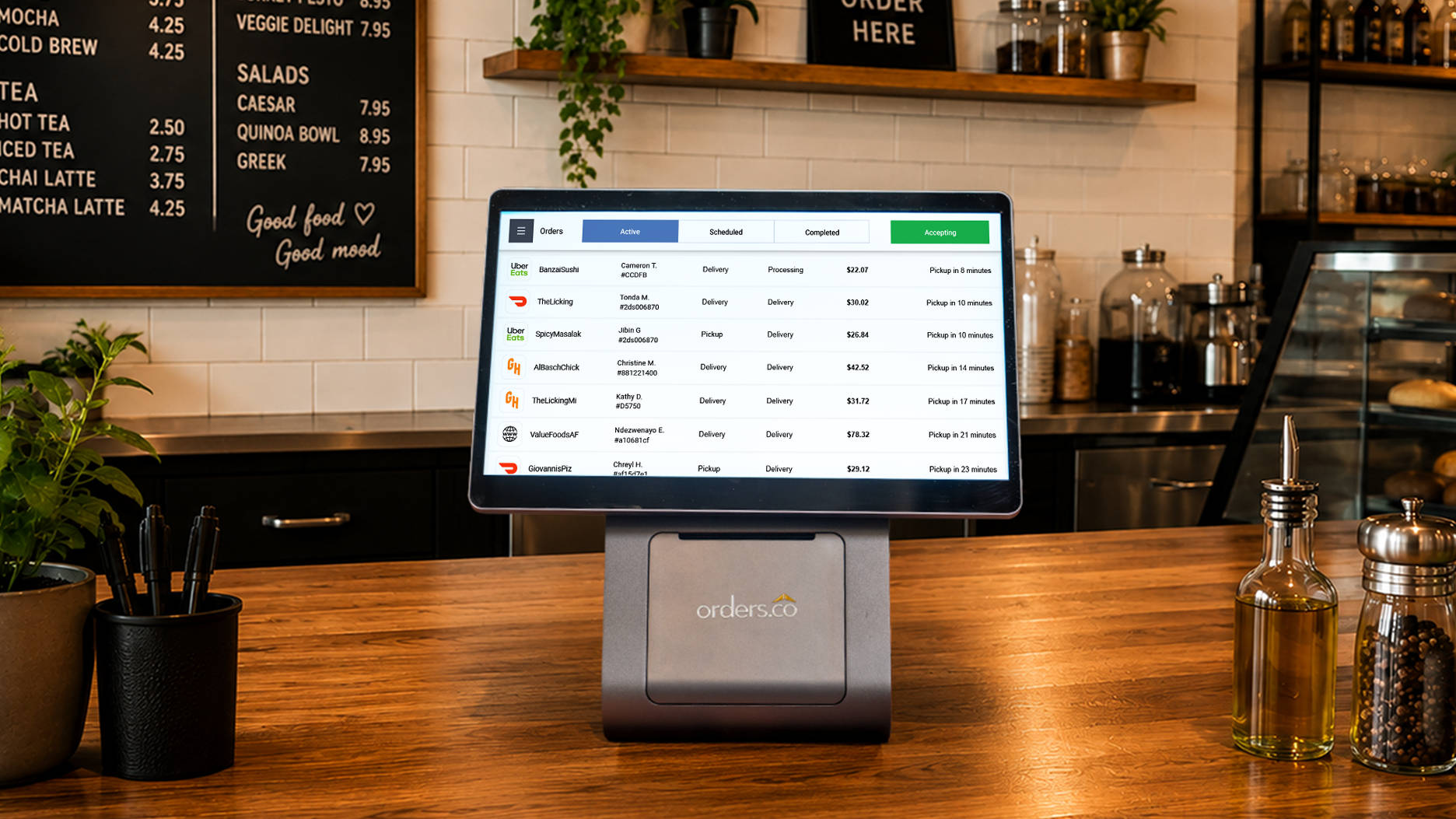
- Order consolidation — every channel feeding into one screen instead of a wall of tablets.
- POS integration — orders flowing in automatically, not re-typed by hand.
- Delivery app management — DoorDash, Uber Eats, and Grubhub handled from one place.
- Direct online ordering — a commission-free website so you keep more of each sale.
- Menu management — update once, sync everywhere, no price mismatches.
- Reporting by channel — knowing which platform and which item actually makes money.
- Loyalty programs — a direct reason for customers to come back.
- SMS and email marketing — automated nudges to past customers based on behavior.
- Review monitoring — catching reputation problems before they spread.
A delivery-first concept can run with fewer of these, but every gap becomes a place where orders, margin, or customers leak out.
How Orders.co Fits Into Delivery-First Restaurant Models
For delivery-first models, the technology stack matters as much as the kitchen.
Platforms like Orders.co exist to handle the operational side of that stack so a small team can run a fast-moving concept without drowning in tablets and spreadsheets. In practice, that means:
- Centralizing incoming orders from multiple channels into one system
- Managing delivery apps from a single place instead of three or four tablets
- Supporting a commission-free direct ordering website
- Helping operators reduce third-party dependency over time
- Keeping menus synced across every channel
- Running loyalty and repeat-customer marketing
- Improving reporting and channel-level visibility
- Replacing a pile of disconnected tools with fewer systems
The point isn’t to switch everything overnight. Many operators start by fixing the loudest problem first, usually delivery chaos and reporting, and decide later whether to move more of their stack over. For a ghost kitchen or q-commerce restaurant, that kind of order consolidation, menu control, and customer ownership is often the difference between a concept that scales and one that quietly bleeds margin.
Which Model Makes More Sense for Your Restaurant?
Ghost kitchen if:
- You want lower real estate costs
- You’re testing a delivery-only concept
- You don’t need a dining room
- You already understand delivery app economics
- Your food travels well
- You have a real plan for customer acquisition
Q-commerce restaurant if:
- Your concept depends on fast, repeat orders
- Your menu can stay compact
- Your food can be prepared quickly and consistently
- You can serve a tight delivery radius
- You want to build direct ordering and loyalty
- You care about speed, convenience, and repeat purchases
Virtual brand if:
- You already have idle kitchen capacity
- You want to test a new concept cheaply
- You can keep inventory and menus organized
- The new brand is meaningfully different from your existing menu
- You can track its profitability separately
Avoid these models if:
- Your menu is too complex to run fast
- Your food doesn’t travel well
- You can’t manage delivery app commissions
- Your staff is already overwhelmed
- You don’t have a clear system for menus, orders, and reporting
The Model Matters, But the System Matters More
The future isn’t simply “ghost kitchens” or “q-commerce.” Those are tools, not destinies.
The future belongs to operators who understand their model, control their channels, and build systems that can handle speed without creating chaos.
A ghost kitchen can lower your overhead. A q-commerce restaurant can increase your speed. A virtual brand can open a new revenue line. But none of them work well without operational control underneath.
The restaurants that win won’t be the ones chasing the trendiest label. They’ll be the ones building profitable, repeatable systems, then picking the model that fits.
Frequently Asked Questions
No. A ghost kitchen is defined by the lack of a traditional dining room: it’s about where the food is made. A q-commerce restaurant is defined by fast digital ordering and fulfillment: it’s about how quickly the order moves. A business can be one without being the other.
Yes. A delivery-only kitchen with a compact menu, short prep times, a tight delivery radius, and a strong digital ordering setup operates as both.
No. A virtual brand is an online-only restaurant brand. It can operate from a ghost kitchen, but it can just as easily run from the kitchen of an existing restaurant that still has dine-in or pickup.
They can be, but it depends on aspects such as rent, labor, menu margins, delivery fees, packaging costs, marketplace commissions, repeat-customer rate, and whether you have a direct ordering strategy. A ghost kitchen lowers overhead, but it doesn’t guarantee profit on its own.
At minimum: online ordering, delivery app integrations, menu management with real-time availability, a POS or order-routing system, customer data capture, loyalty tools, marketing automation, and reporting by channel.


