


- Why Virtual Brands Are the Fastest Low-Risk Growth Channel Right Now
- Step-by-Step: How to Launch a Virtual Brand Without Derailing Your Main Restaurant
- Managing Two Brands from One Kitchen — The Operational Reality
- The Real Benefits of Running a Virtual Brand
- 5 Pitfalls That Sink Most Virtual Brand Launches
- The Tech Stack You Actually Need to Run a Multi-Brand Operation
- How to Manage It All Without Hiring a Tech Team
- The Bottom Line: The Window Is Open — But Not Forever
- Frequently Asked Questions About Virtual Brand Restaurants
The question isn’t whether you have the capacity of managing virtual brands — it’s whether you have the right system to launch one without it breaking everything else.
Virtual brands — delivery-only restaurant concepts that run out of your existing kitchen with no storefront — have gone from niche experiment to mainstream growth strategy. Major chains tested them first. Now, independent operators from Brooklyn to Phoenix are quietly adding $5,000 to $20,000 a month in revenue by running a second or third concept from the same kitchen, targeting different customer segments, and tapping into delivery demand that was already there.
The opportunity is real. But so are the landmines. Operators who rush in without validating their concept, building the right menu, or setting up the right technology end up with an operational nightmare that hurts their core business. Those who get it right build a second revenue stream that essentially pays for itself.
This guide gives you the complete step-by-step playbook — from concept to launch to daily operations — along with the tech stack you actually need to make it work.
Why Virtual Brands Are the Fastest Low-Risk Growth Channel Right Now
Opening a second location costs $250,000 to $500,000 and takes six to twelve months. Launching a virtual brand can cost under $1,000 and go live in two weeks. That’s the core math that’s driving adoption across every type of restaurant operation.
The global ghost kitchen and virtual brand market is projected to surpass $1 trillion by 2030 (Euromonitor). DoorDash reports that restaurants operating virtual brands alongside their physical locations see measurable increases in overall delivery revenue — without incurring high overhead costs.
The model works because it uses what you already have: your kitchen, equipment, team, and inventory. A burger restaurant can run a smash-burger virtual brand and a loaded-fries concept simultaneously, using the same beef and the same fryer. A pizza shop can spin up a pasta delivery concept with minimal additional prep. The key is building around what you already do well — and what your market is already searching for on delivery apps.
The Numbers
| $1T+ | Projected global virtual brand/ghost kitchen market by 2030 (Euromonitor) |
| 30% | Fewer missed orders for operators using consolidated order management |
| 25% | Faster order processing with an integrated POS system |
| 68% | Businesses say app integration meaningfully improved their overall performance |
Step-by-Step: How to Launch a Virtual Brand Without Derailing Your Main Restaurant
Most virtual brand failures aren’t failures of execution — they’re failures of planning. Here’s the framework that works.
| Step 1 Validate the Concept Before You Build Anything |
| Open DoorDash and Uber Eats in your delivery radius. What’s ranking? What’s missing? Gaps = opportunity.Look for underserved niches: late-night comfort food, plant-based options, spicy chicken, loaded fries, smash burgers.Talk to your kitchen team — they hear what customers ask for and can’t find.Check search volume for your concept idea using Google Trends or keyword tools.If there are already 15 wings concepts in your area, find a different angle. If there are zero, explore why. |
| Step 2 Build a Menu That Runs on What You Already Have |
| Start with 4–6 items maximum. A tight menu performs better on delivery apps and puts less pressure on your kitchen.Map every item back to existing inventory — zero new ingredients is the goal for version one.Avoid dishes with long cook times, complex plating, or fragile packaging. Food delivery needs to survive a 15-minute ride.Test items internally before publishing. Your team should be able to execute them during a busy Friday night without dropping service.Price for delivery margins: factor in platform commissions (15–30%) and packaging costs before you set your final prices. |
| Step 3 Build a Brand That Earns Trust Online |
| Choose a name that is specific, memorable, and communicates the concept immediately. ‘Firebird Wings’ or ‘No Fork Noodles’ beats ‘Grill & More.’Invest in professional food photography — it’s the single highest-ROI expense in a virtual brand launch.Write menu descriptions that sell the food, not just describe it. ‘Crispy buttermilk fried chicken, house hot sauce, pickled jalapeños’ beats ‘Fried chicken sandwich.’Your virtual brand should feel like its own restaurant — not like a side project from your main concept. |
| Step 4 Go Live on Delivery Platforms the Right Way |
| Register your virtual brand as a separate listing on DoorDash, Uber Eats, and Grubhub. Most platforms support this.If you operate multiple brands, negotiate multi-brand commission discounts — most platforms offer them, and most operators never ask.Use platform promotions in the first 30 days. Introductory discounts and free delivery offers dramatically increase early visibility.Make sure every item has a photo. Listings without photos significantly outperform those with photos.Double-check that your operating hours, address, and pickup instructions are accurate and match your actual capacity. |
| Step 5 Track Everything and Improve Constantly |
| Monitor sales by item in the first two weeks. Items with zero orders should be replaced or removed.Track refund and complaint reasons — most early issues are packaging or missing item problems that are easy to fix.Compare prep time per order against your main restaurant to identify bottleneck items.Treat your virtual brand like a startup: run it lean, measure everything, and double down on what works.Large restaurant groups test 10–20 virtual concepts before scaling the top 2–3. Apply the same mindset. |
Managing Two Brands from One Kitchen — The Operational Reality
The launch is the easy part. The ongoing challenge is running a virtual brand at full speed alongside your physical restaurant without the wheels coming off on both.
| “The first week we went live on a second brand, our kitchen got slammed. Not because of volume, because nobody knew which ticket was for which concept. We lost three orders and had two wrong deliveries in one night. It was completely avoidable with the right setup.” — Multi-concept operator, Dallas |
The operators who manage this well have three things locked in before they go live:
- A labeling system — color-coded tickets, packaging stickers, or kitchen display zones that make it immediately obvious which order belongs to which brand
- A trained team — every kitchen staff member knows the menu, the packaging specs, and the station workflow for each brand before the first order comes in
- A unified POS — all orders from all channels flow into one screen, in one queue, with clear brand labeling, so no ticket gets lost between a DoorDash tablet and your regular POS
On the inventory side, track ingredient usage per brand separately from day one. This tells you the actual food cost by concept, helps you spot when a virtual brand is cannibalizing margin from your main menu, and gives you the data to make smart purchasing decisions as volume scales.
Operationally, the biggest risk with virtual brands isn’t the virtual brand failing — it’s the virtual brand succeeding too fast and overwhelming your kitchen. Cap your virtual brand order volume in the first few weeks by limiting your delivery radius or turning off one platform during peak dine-in hours. You can always scale up. Recovering from a flood of bad reviews during an overwhelmed Friday night is much harder.
The Real Benefits of Running a Virtual Brand
If the operational overhead is managed well, the upside is significant — and it compounds over time.
More revenue from existing overhead. Your rent, utilities, and equipment costs don’t change when you add a virtual brand. Every order from a virtual concept runs at a higher margin than your first dollar of revenue because your fixed costs are already covered.
A low-risk product testing ground. Want to know if a Korean BBQ concept has legs in your market? Launch it as a virtual brand and find out before you invest in a full build-out. If it works, scale it. If it doesn’t, shut it down with no lease to worry about.
Access to new customer segments. Your core restaurant has a core customer. A virtual brand with a different concept, name, and positioning reaches people who would never find your main restaurant — late-night eaters, health-conscious orderers, families looking for something different — without you changing a thing about your main brand.
Maximizing kitchen downtime. Most restaurants have dead hours — 2 p.m. to 5 p.m. on weekdays, Sunday mornings, and slow Tuesday nights. A virtual brand running on delivery during those windows turns idle labor and equipment into revenue.
5 Pitfalls That Sink Most Virtual Brand Launches
Virtual brands fail fast when these mistakes aren’t avoided up front:
| Pitfall | Why It Hurts |
|---|---|
| Skipping market validation | Launching a concept with no demand means burning time, money, and kitchen bandwidth on a brand nobody orders. |
| Overloading the kitchen | Too many SKUs or complex dishes create bottlenecks that hurt both your virtual brand and your main restaurant service. |
| Weak or generic branding | On a delivery app, you’re competing visually. Poor photography, a forgettable name, and no story kill click-through rates. |
| Wrong tools for multi-brand ops | A POS that wasn’t built for virtual brands will create order confusion, missed tickets, and reporting blind spots. |
| Ignoring the data | Operators who don’t track sales by brand, refund rates, and prep times can’t tell what’s working — and scale the wrong thing. |
The Tech Stack You Actually Need to Run a Multi-Brand Operation
The right tech stack isn’t complicated, but every layer needs to pull its weight:
| Tool | What It Does for Multi-Brand Operators |
|---|---|
| All-in-one POS | Consolidates orders from your physical restaurant and all virtual brands into one interface — no separate tablets, no missed tickets. |
| Menu management tool | Update and sync menus across every delivery platform instantly. Change a price or 86 an item once; it updates everywhere. |
| Direct ordering website builder | Give each virtual brand its own commission-free ordering page so you’re not giving 30% to apps on every order. |
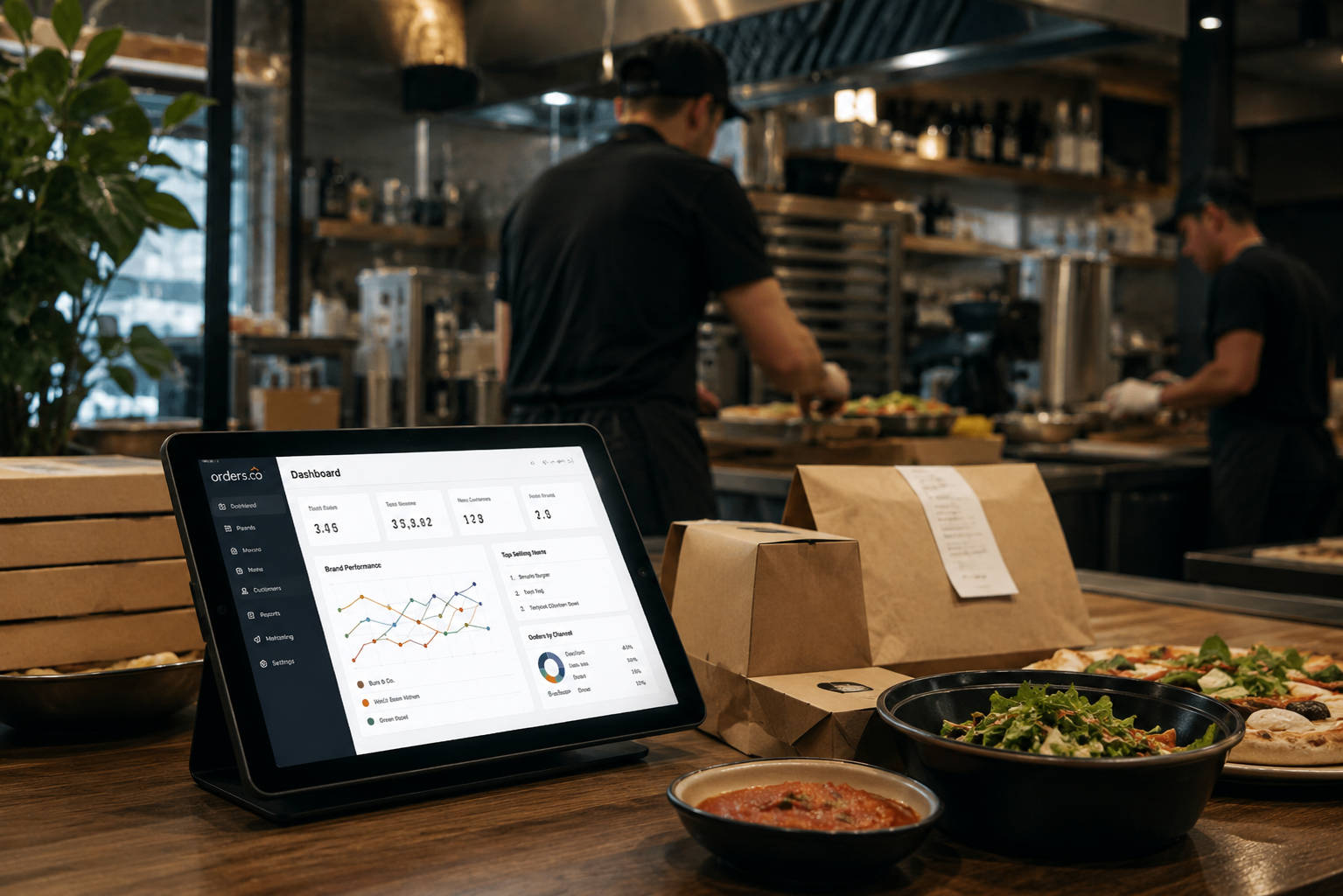
| Analytics & reporting dashboard | Track revenue, refunds, prep times, and customer feedback per brand so you know exactly what to scale and what to cut. |
| Built-in marketing tools | Run promotions, loyalty programs, and SMS/email campaigns per brand without adding more subscriptions. |
| Delivery dispatch (in-house + 3rd party) | Manage your own drivers for nearby orders and overflow to third-party couriers during peak hours — all from one screen. |
How to Manage It All Without Hiring a Tech Team
You don’t need an in-house developer, a dedicated operations manager, or a six-month implementation timeline to run multiple brands well. What you need is a platform built for exactly this kind of operation.
“Before Orders.co, I had three tablets and a spreadsheet to run two brands. Now everything comes into one screen. My kitchen team knows exactly what’s for which brand, and I can actually see which concept is making money and which one isn’t.”
– Ghost kitchen operator, Houston
The Bottom Line: The Window Is Open — But Not Forever
Your kitchen is already an asset. A virtual brand is the fastest way to put it to work.
Frequently Asked Questions About Virtual Brand Restaurants
A virtual brand restaurant is a delivery-only restaurant concept that operates out of an existing kitchen without its own storefront. Instead of opening a second physical location, a restaurant can create a separate online brand, menu, and delivery listing using the staff, equipment, and ingredients it already has.
A virtual brand is the restaurant concept itself, while a ghost kitchen is the physical kitchen space where delivery-only brands operate. For example, a pizza shop could launch a virtual pasta brand from its existing kitchen. A ghost kitchen, on the other hand, may be a delivery-only facility that hosts one or several brands with no dine-in restaurant attached.
Start by validating demand in your delivery radius. Check what is ranking on DoorDash, Uber Eats, and Grubhub, look for gaps in local cuisine options, and build a small menu around ingredients and equipment you already use. From there, create a clear brand name, add strong food photography, set up delivery listings, and connect your orders, menus, and reporting through a system that can handle multi-brand operations.
The best virtual brand menu is small, delivery-friendly, and easy for your kitchen to execute during rush hours. Start with 4–6 strong items, avoid dishes that are fragile or slow to prepare, and use ingredients already in your inventory. A focused menu is easier to manage, easier to market, and less likely to overwhelm your team.
Launching a virtual brand usually costs far less than opening a new restaurant location because you are using your existing kitchen, staff, equipment, and inventory. Main costs may include branding, photography, packaging, delivery platform setup, promotions, and technology to manage orders and menus. The exact cost depends on your concept, platforms, and how much creative work you handle in-house.
Yes, but it should be done carefully. A small restaurant can run multiple virtual brands if the menus are simple, the workflows are clear, and the team has a reliable way to identify which order belongs to which brand. Without the right POS, menu management, labeling, and reporting setup, multiple brands can quickly create ticket confusion, missed orders, wrong packaging, and staff stress.
The biggest mistakes are launching without market research, creating too many menu items, copying the main restaurant menu too closely, using weak branding, ignoring packaging, and relying on separate tablets for every delivery app. Many virtual brands fail not because the idea is bad, but because the operation is not set up to handle multi-brand order flow.
Use clear brand labeling, separate packaging rules, staff training, and one centralized order queue. Every ticket should show which brand it belongs to, what packaging it needs, and where it should be routed. A unified POS or order management system helps prevent staff from jumping between tablets or manually re-entering orders during busy shifts.
Menu management is critical because every price change, sold-out item, modifier, and description needs to stay consistent across multiple delivery apps and direct ordering channels. If your virtual brand menu is updated manually in several places, mistakes are almost guaranteed. Centralized menu management lets you update once and push changes everywhere, reducing errors and customer complaints.
Orders.co helps restaurants run virtual brands by bringing delivery orders, direct online orders, menu management, reporting, and marketing tools into one connected system. Instead of managing separate tablets and dashboards for every brand and platform, operators can track orders in one place, update menus across channels, monitor brand performance, and reduce the operational chaos that often comes with multi-brand restaurant operations.


