


- Chili’s Turnaround Has a Surprisingly Simple Tech Lesson
- Burger King Is Investing in the Restaurant, Not Just the App
- Starbucks and McDonald’s Are Using Tech to Protect Hospitality
- How the Big-Chain Moves Translate to Independent Scale
- 5 Big-Chain Lessons a Small Restaurant Can Use This Week
- What Small Restaurants Should Not Copy
- Innovation That Doesn’t Look Like Innovation
- FAQ
- More Helpful Reads
Big restaurant chains have the budgets to buy almost any technology they want: AI, kitchen robotics, predictive ordering, and computer vision. Yet several of 2026’s most talked-about restaurant comebacks are being driven by far less exotic work: better Wi-Fi, faster order-entry screens, smarter kitchen routing, newer equipment, and shorter checklists. Small restaurants should copy how big chains decide where technology goes, not how much they spend getting there. The most useful investments solve recurring operational friction before they add anything new.
Chili’s Grill & Bar is the clearest example. Its parent company, Brinker International, has spent the past two years modernizing the unglamorous infrastructure that restaurant teams touch every shift. This article looks at what Chili’s, Burger King, Starbucks, and McDonald’s are actually doing in 2026, and translates each move into a decision an independent operator can make. The priority order is the lesson. The price tag is not.
Chili’s Turnaround Has a Surprisingly Simple Tech Lesson
Chili’s rebuilt the technology its staff use during service before chasing anything experimental, and the payoff shows up as steadier execution rather than one flashy feature.
Brinker International reported on August 12, 2026, that Chili’s comparable restaurant sales rose 5.6% in fiscal fourth-quarter 2026, with positive traffic. Restaurant Business reported the same day that the brand had posted 21 consecutive quarters of positive same-store sales, describing an approach built on operational basics. Brinker credits that run to disciplined execution across food quality, service, atmosphere, menu innovation, everyday value, marketing, and restaurant investment. Technology is one input, not the cause.
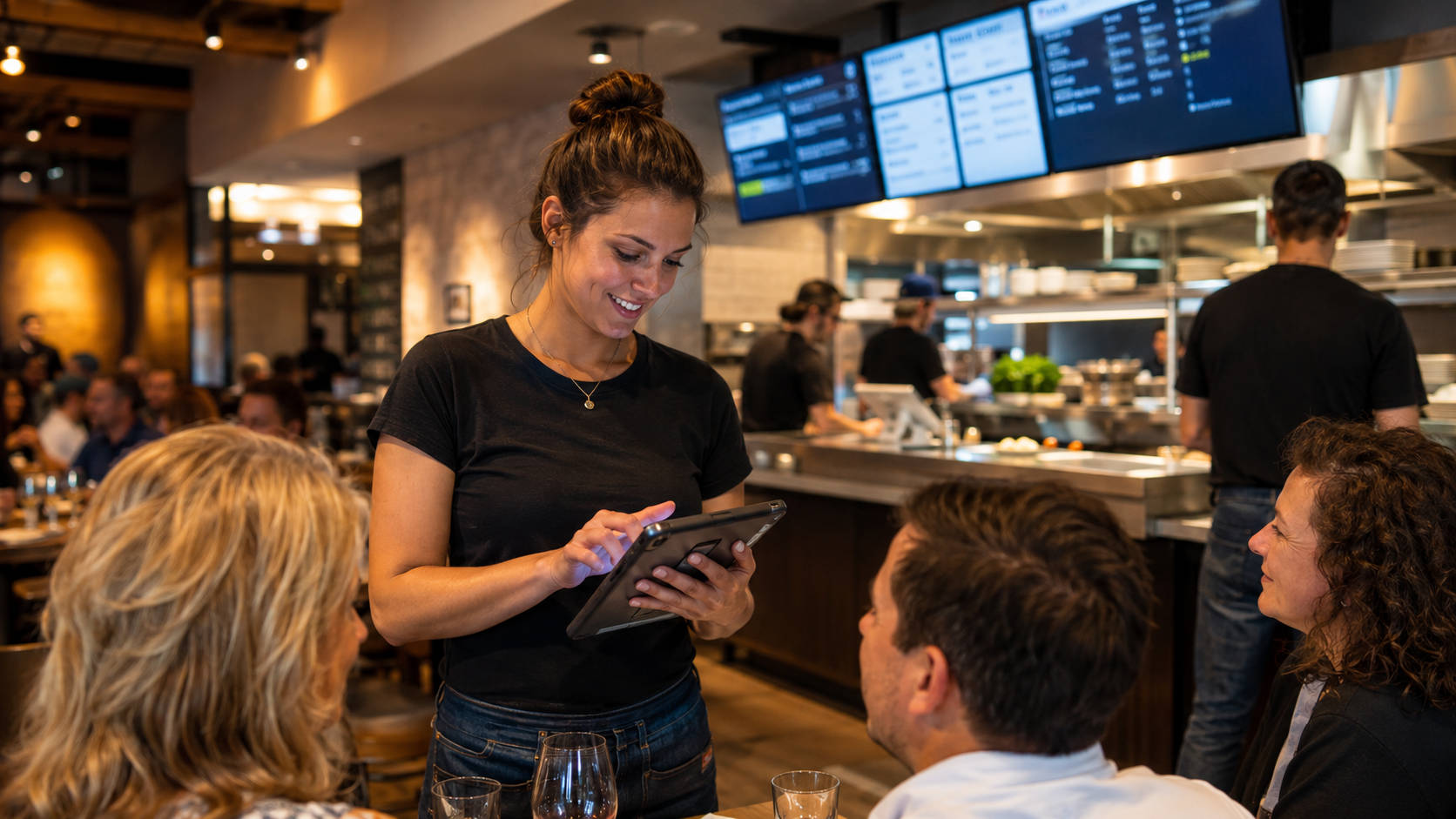
The technology work itself was deliberately practical. Under Chief Information Officer Chris Caldwell, Chili’s deployed roughly 23,000 new iPads to restaurant teams and modernized about 9,000 kitchen touchscreens. What matters more than the count is what changed on those screens: kitchen displays were redesigned to show each station only the work relevant to it, instead of an overwhelming full ticket. The company has also tested an order-entry interface built to cut the clicks needed to ring in an order by roughly half. Caldwell’s sequence was intentional. Repair the core infrastructure first, then decide where AI actually earns its place.
The same discipline shows up away from the screens. Chili’s cut manager pre-shift line checks from about eight pages to one, freeing roughly 30 minutes a day. The company studies its highest-volume restaurants to find bottlenecks, and treats seconds, clicks, and unnecessary tasks as real operating costs.
Chili’s did not get better because it bought tablets. It got better because it watched real restaurant work, found the friction that repeated every shift, removed it, and checked whether service actually got easier. That method is the part that a small operator can borrow. You do not need 23,000 iPads to ask which three things slow your line down every Friday, then fix them one at a time.
Burger King Is Investing in the Restaurant, Not Just the App
Burger King’s recent gains came from fixing the physical restaurant and its operations, a reminder that restaurant technology is as much equipment and layout as it is software.
Restaurant Brands International reported on August 6, 2026, that Burger King U.S. comparable sales rose 8.5% in second-quarter 2026, which Restaurant Business described as the brand’s best U.S. comparable-sales performance in three years. RBI Chief Executive Officer Josh Kobza framed the result as what happens when a brand invests in fundamentals and executes well, connecting the quarter to years of operational work, remodels, product improvements, and marketing.
Much of that groundwork sits inside Burger King’s Reclaim the Flame plan, which commits up to $700 million of investment through the end of 2028. The Royal Reset portion targets the physical restaurant: remodels, kitchen equipment, building improvements, technology, and better operations. It is a mix of digital and physical, and the physical side carries as much weight as any app.
That is the point for independent operators. A broken pickup flow, an oven that cannot keep up, a dead menu board, or an online order process that customers abandon can cost you more than picking the wrong software. You do not need a national remodel program to apply the idea. Walk into your own restaurant and ask a few honest questions. Is the pickup area causing congestion? Is aging equipment slowing production? Are online and in-store orders entering the same workflow, or two different ones? Is your team working around the technology instead of through it? Fixing one of those is closer to Reclaim the Flame than any single purchase.
Starbucks and McDonald’s Are Using Tech to Protect Hospitality
The most useful automation in these chains is not replacing employees. It is clearing operational noise, so staff have more attention for guests.
Starbucks uses two tools worth noting. Smart Queue coordinates orders arriving through the café, drive-thru, mobile, and delivery so the kitchen can sequence production instead of reacting to whichever order arrived loudest. Green Dot Assist gives partners fast answers to operational questions about recipes, procedures, and service standards. Starbucks describes its technology strategy as strengthening customer and employee interactions rather than replacing them. In August 2026, the company reported North American comparable sales up more than 8% and visits up 4.5%, crediting both customer connection and operational improvement.
McDonald’s makes the hospitality case explicitly. In its McDonald’s > NEXT strategy, announced June 1, 2026, the company observed that as more of the ordering journey becomes automated, employees have fewer chances to interact with guests, which makes each remaining interaction more important, not less.
Put those together, and you get a simple rule. The best restaurant automation gives people more time to do the parts of hospitality that should never be automated. You may not run Smart Queue, but you make the same choice every time you decide whether a new tool frees your staff to greet a guest or just adds another screen to watch.
How the Big-Chain Moves Translate to Independent Scale
The pattern holds across all four brands. Each started with a specific operational problem, then chose technology to solve it. Here is how those moves come down to an independent scale.
| Big-chain move | Problem being solved | Small-restaurant version |
| Chili’s improves tablets and kitchen screens | Order-entry and kitchen friction | Fix POS and order routing before adding tools |
| Burger King upgrades stores and equipment | Poor execution and guest experience | Repair obvious operational bottlenecks |
| Starbucks Smart Queue | Multiple order channels competing for production | Route digital orders into one workflow |
| McDonald’s hospitality focus | Fewer human interactions | Automate admin, protect guest interaction |
5 Big-Chain Lessons a Small Restaurant Can Use This Week
These four brands spend at a scale you never will. The best restaurant technology for small restaurants is rarely the newest thing on the market, and the decisions behind big-chain spending are ones you can copy this week without a budget line.
1. Audit friction before you shop for software
Before you evaluate a single tool, follow one busy shift from the moment an order is placed to the moment it is paid for or handed off. Watch for re-entry, repeated clicks, staff switching between screens, people waiting on equipment, missing modifiers, confusing tickets, manager approvals, bottlenecks, and the workarounds your team has quietly accepted as normal. The friction you find is your shopping list. The tool comes after, if at all.
2. Reliability beats novelty
If your Wi-Fi drops, your POS terminals freeze, your printers jam, your kitchen routing misfires, or your online orders do not reliably come through, fix those before you experiment with anything advanced. A boring system that works every Friday night is worth more than an impressive feature your staff cannot trust. Chili’s repaired its foundation first for a reason. If you are setting up a new location, the same logic drives what to put on your pre-open tech checklist before anything else.
3. More customer channels should not mean more staff workflows
Your customers will find you through your website, DoorDash, Uber Eats, Grubhub, Google, and the phone. Those are discovery channels, and more of them is usually good. The problem starts when each one becomes a separate tablet, a separate menu to update, and a separate re-entry into the POS. The kitchen ends up running several small restaurants at once. Order consolidation, POS integration, and menu synchronization collapse that duplicate work back into one flow. If you are weighing how much of this you actually need, how many online ordering systems a restaurant needs is a useful place to start.
4. Measure friction, not feature count
Judge a change by whether it removes work, not by how many features it adds. Track things you can see on the floor: order-entry time, manual handoffs per order, training time for a new hire, order errors, ticket times, missed orders, pickup or table-turn waits, and the number of separate systems your staff touches to complete one order. If a new tool does not move one of those, it is decoration.
5. Automate backstage so hospitality improves out front
Use technology for the repetitive work behind the scenes: order routing, reporting, menu updates, scheduling support, and consolidating orders from every channel. The McDonald’s point applies at any size. The fewer forced tasks your staff carry, the more attention they have for the food and the guest. The goal is not only fewer labor minutes. It is employees who can look up from a screen.
What Small Restaurants Should Not Copy
The one thing not to take from these stories is the scale. Do not look at 23,000 tablets or hundreds of millions of dollars in remodels and conclude you need a sweeping transformation project of your own. That is the opposite of the lesson. The method is small and repeatable: identify your single biggest recurring bottleneck, fix it, confirm your team actually uses the fix, measure whether service got easier, then move to the next one. Resist replacing systems that already work just because something newer exists. Enterprise brands can afford to bet on experiments. Your budget rewards fixing what breaks every shift.
Innovation That Doesn’t Look Like Innovation
Restaurant innovation does not always look innovative. Sometimes it looks like a faster ticket screen, an order connection that never drops, one fewer tablet on the counter, a shorter manager checklist, an oven that keeps up, or an employee who finally has a second to look a guest in the eye.
You may not have an enterprise technology budget, but you can build the same operational discipline the big chains are using. Start by connecting the systems that already handle your orders, menus, kitchen workflow, and customer channels so your team stops doing the same work twice. If the POS is where that fragmentation begins, knowing what to check before choosing one helps. A connected platform like Orders.co is built to pull delivery apps, direct online ordering, menus, and reporting into one place, which is the independent-scale version of the foundation Chili’s rebuilt before it reached for anything new.
FAQ
A small restaurant should invest first in technology that fixes its biggest recurring operational problem. For many restaurants, that means a reliable POS system, connected online ordering, kitchen order routing, or menu management before experimenting with more advanced AI tools. The goal should be fewer manual steps, fewer errors, and a smoother workflow—not simply adding more software.
Restaurants commonly use POS systems, kitchen display systems (KDS), online ordering platforms, delivery integrations, inventory software, employee scheduling tools, digital payments, and reporting platforms. The biggest efficiency gains usually come when these systems share data and orders automatically instead of requiring employees to re-enter information across multiple devices or platforms.
Not every small restaurant needs a kitchen display system. A low-volume café or single-station kitchen may work well with printed tickets. A KDS becomes more valuable as order volume, menu complexity, preparation stations, and online ordering channels increase because it can organize tickets, modifiers, timing, and order routing in one kitchen workflow.
Restaurant online ordering can be connected to a compatible POS either through a native integration or an integration platform. Once connected, orders from a website or third-party delivery platform can flow into the restaurant’s POS and kitchen workflow without employees manually re-entering each ticket. Menu and order data may also stay synchronized depending on the integration.
There is no single technology budget that fits every restaurant. Instead of starting with a percentage or fixed dollar amount, operators should evaluate what a technology problem currently costs them in staff time, errors, missed orders, slow service, or lost sales. A technology investment makes more sense when it solves a measurable problem, and its impact can be tracked after implementation.
Small restaurants can use AI for tasks such as demand forecasting, scheduling support, inventory analysis, review management, customer marketing, reporting, and automated ordering. The best place to start is usually one repetitive problem that consumes significant employee or manager time. AI should make existing restaurant operations easier rather than adding another disconnected system employees have to manage.


