


- Introduction: Ghost Kitchens Look Simple — Until the Orders Start Coming In
- What Is a Ghost Kitchen?
- Why the Ghost Kitchen Model Is Attractive
- Mistake #1: Launching Too Many Virtual Brands Too Quickly
- Mistake #2: Depending Only on DoorDash, Uber Eats, and Grubhub
- Mistake #3: Not Knowing Which Channel Is Actually Profitable
- Mistake #4: Running the Kitchen on Too Many Tablets
- Mistake #5: Updating Menus Manually Across Every Platform
- Mistake #6: Choosing a POS That Does Not Connect to Delivery Apps
- Mistake #7: Not Building a Direct Ordering Channel
- Mistake #8: Ignoring Reviews and Customer Feedback
- Mistake #9: Not Planning Inventory Around Delivery-Only Demand
- Warning Signs Your Ghost Kitchen Operation Is Getting Too Complicated
- What Ghost Kitchens Need to Stay Profitable
- How Orders.co Helps Ghost Kitchens Avoid These Mistakes
- Final Takeaway: A Ghost Kitchen Needs More Than a Kitchen
Introduction: Ghost Kitchens Look Simple — Until the Orders Start Coming In
A ghost kitchen launches three virtual brands out of one small kitchen. The first week feels great. DoorDash rings. Uber Eats rings. Grubhub rings. The new wing brand starts pulling orders nobody expected. It feels like the model is working.
Then the cracks show up.
One tablet says the spicy chicken sandwich is available. Another app is still showing last month’s price. The kitchen is firing tickets for three different concepts at the same time, and a line cook is squinting at a tablet, trying to figure out which brand a ticket even belongs to. Staff are reading orders off a screen and re-typing them into the POS. By the end of the week, refunds are climbing, a couple of one-star reviews land, and the owner honestly can’t say which of the three brands is making money.
A ghost kitchen can be a smart way to test a concept or grow delivery revenue. But that only holds true if the operation is actually built to handle digital complexity.
Here’s the part most people miss: a ghost kitchen does not fail only because of food quality. It usually fails because the orders, menus, delivery apps, payments, reporting, and customer relationships were never connected in the first place.
This guide breaks down why ghost kitchens fail, the nine mistakes that quietly sink delivery-only operations, and what you actually need to stay profitable.
What Is a Ghost Kitchen?
A ghost kitchen is a delivery-only food business that prepares meals for online orders without a traditional dining room. Customers order through delivery apps, a restaurant website, social media links, or other direct online ordering channels — and the food goes straight out the door for pickup or delivery.
Ghost kitchens can run out of:
- Commercial kitchen spaces
- Shared or commissary kitchen facilities
- Warehouse-style kitchens
- An existing restaurant’s kitchen during slower hours
- Small prep spaces built mainly for delivery
These setups are usually small — many delivery-only spaces run anywhere from about 50 to a few hundred square feet — and they took off after 2020 when off-premise ordering exploded.
Unlike a traditional restaurant, a ghost kitchen doesn’t live or die on foot traffic, servers, or the dining room experience. It depends on speed, online visibility, menu accuracy, delivery performance, and repeat online orders. Every one of those things runs through software. That’s the whole game.
Why the Ghost Kitchen Model Is Attractive
Before we talk about failure, it’s worth being honest about why so many operators choose this model. The appeal is real.
| Benefit | Why It Appeals to Operators |
| Lower rent | No need for a high-traffic dining room location |
| Fewer front-of-house staff | No hosts, servers, or dining room team required |
| Faster concept testing | Test menus or brands before committing to a full restaurant |
| Delivery-first growth | Built around where many customers already order |
| Multiple virtual brands | One kitchen can run more than one concept |
| Lower starting risk | Smaller footprint and far lower buildout costs |
Economics can be genuinely friendlier. A traditional full-service restaurant often needs somewhere around $60,000 to $100,000 in monthly sales just to be profitable. A lean delivery-only kitchen can reach break-even at a much lower number — often in the $30,000 to $60,000 range — because rent is smaller and the labor model is tighter.
But lower rent does not automatically mean lower complexity. In many cases, the complexity just moves. It leaves the dining room and shows up in the digital operation instead. That’s where most ghost kitchens get into trouble.
Mistake #1: Launching Too Many Virtual Brands Too Quickly
Many operators assume that more brands automatically mean more revenue. One kitchen could theoretically run burger, wing, salad, taco, and dessert brands off the same equipment. On paper, it’s five revenue streams. So why not launch all of them?
Because every new brand adds a new layer of work.
Each brand may need its own menu, its own delivery app listings, its own pricing, its own photos, its own packaging, its own prep steps, its own inventory, its own reviews to manage, and its own reporting to track.
There’s a well-known cautionary tale from around 2021: an operator running five concepts out of one kitchen using somewhere between 18 and 20 tablets. The food wasn’t the problem. The chaos was. Tracking inventory and updating out-of-stock items across all those listings became nearly impossible.
The marketplaces eventually noticed the abuse, too. Around 2023, platforms like Uber Eats and DoorDash began requiring virtual brand menus to be meaningfully distinct — roughly 70% to 80% different from the primary location — to curb operators from spinning up near-duplicate brands.
The takeaway is simple. More brands only help if your kitchen can manage them clearly. Otherwise, each new brand is just another place for mistakes to hide. If you’re running several concepts, you need one place to see what’s selling, what’s out of stock, and which channels are actually worth keeping.
Mistake #2: Depending Only on DoorDash, Uber Eats, and Grubhub
Delivery apps are useful, full stop. Ghost kitchens need visibility, and the marketplaces are very good at putting new brands in front of millions of hungry people. That’s their job, and they do it well.
The mistake isn’t using them. The mistake is treating them as the entire business.
When a ghost kitchen depends only on third-party apps, it hands over control of:
- Customer relationships
- Customer data (names, emails, phone numbers)
- Repeat marketing
- Fees and commissions, which commonly run 15% to 30% per order
- The brand experience
- Ranking and visibility
- Any communication after the order
Nobody is telling you to delete DoorDash. For a delivery-only brand, that would be unrealistic. The better approach is this: use delivery apps for discovery, and build direct ordering for repeat customers. Let the marketplaces introduce you to new diners, then give those diners a reason and a way to come back to you directly.
Mistake #3: Not Knowing Which Channel Is Actually Profitable
A ghost kitchen can be busy and broken at the same time.
More orders do not always mean more profit. One platform might bring high volume on thin margins. Another might bring fewer orders but bigger tickets. A direct ordering channel might start slow but be far more profitable per order because there’s no commission eating into it.
If you can’t see those differences clearly, you’re flying blind. Here’s what you actually need to watch:
| Metric | Why It Matters |
| Sales by platform | Shows where orders are coming from |
| Profit by channel | Shows which platforms are worth the cost |
| Average ticket size | Helps compare order quality |
| Refunds and disputes | Reveals hidden revenue leaks |
| Menu item performance | Shows what should stay, change, or go |
| Repeat customer rate | Shows whether the brand has staying power |
| Prep time and delays | Affects delivery app rankings and reviews |
A ghost kitchen can look busy and still be losing money.
This is why reporting matters more than people think. You need one dashboard that shows sales and performance across every channel, not three separate reports from three apps that never quite line up.
Mistake #4: Running the Kitchen on Too Many Tablets
Picture the back counter of a struggling ghost kitchen:
- One DoorDash tablet
- One Uber Eats tablet
- One Grubhub tablet
- A separate tablet for one of the virtual brands
- A POS screen
- A printer
- A spreadsheet
- The manager’s personal phone
That setup limps along fine at 2 p.m. Then 7 p.m. hits.
When systems are disconnected, your staff inherit the gap. That means missed orders, incorrect orders, delayed prep, refunds, frustrated customers, and reviews that drag down your ranking.
And here’s the thing worth saying out loud: tablet chaos is not a staff problem. It is a system problem. Good people lose orders when they’re forced to watch five screens at once during a rush. No amount of hustle fixes a broken setup.
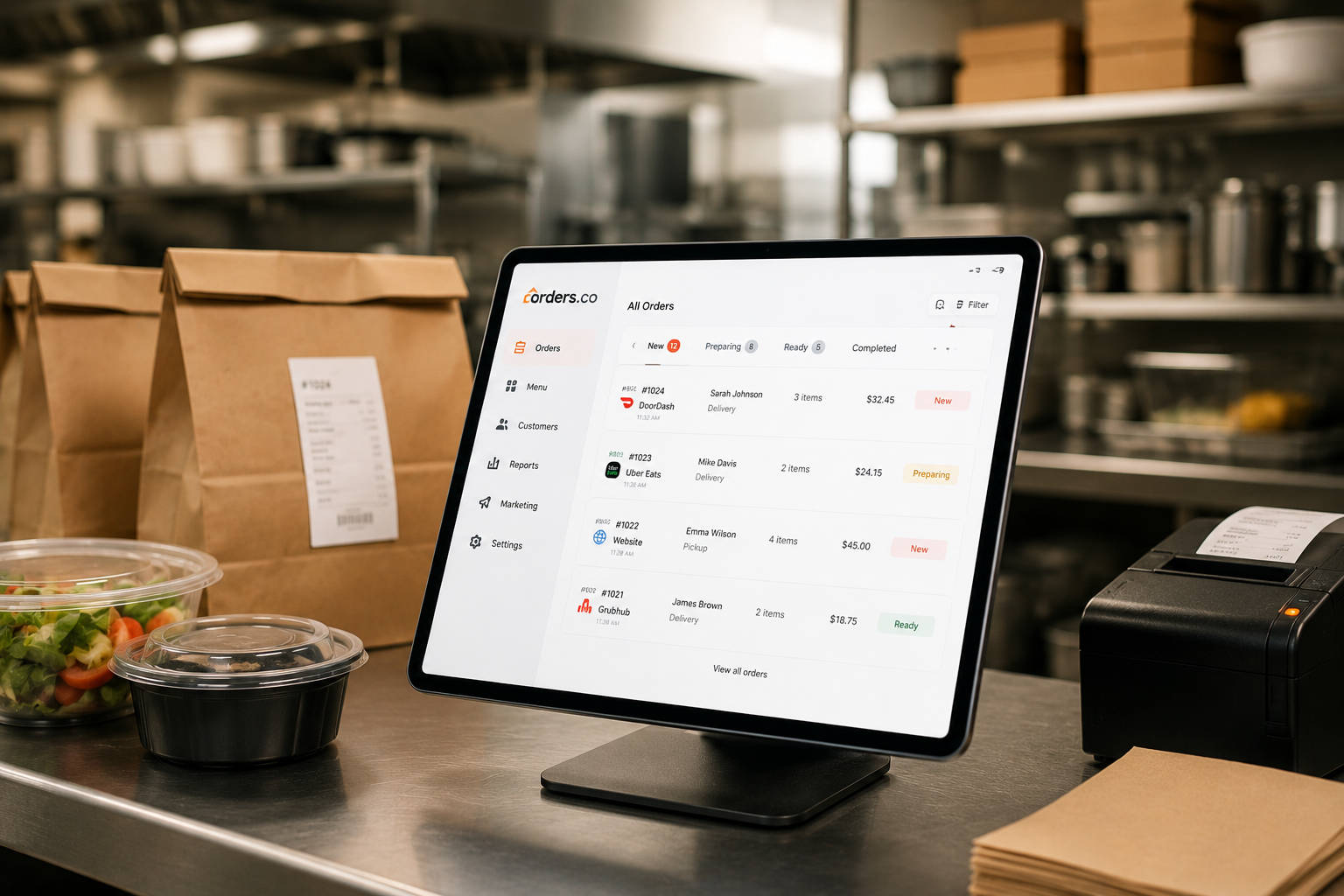
This is exactly where order consolidation earns its keep — pulling every delivery order into one screen so your team isn’t bouncing between devices and re-keying tickets.
Mistake #5: Updating Menus Manually Across Every Platform
In a ghost kitchen, the menu is the storefront. There’s no sign, no window, no host. The online listing is the entire first impression. So menu accuracy isn’t a nice-to-have — it’s the business.
When you update menus by hand across multiple apps, things drift fast. Common problems:
- Wrong prices on one platform
- Sold-out items still showing as available online
- Missing or mismatched modifiers
- Old photos and stale descriptions
- Different item names across different apps
- Staff are unsure which menu is the current one
- Customers ordering items that the kitchen can’t actually make
Every one of those turns into a refund, a complaint, or a cancellation.
For ghost kitchens, the menu is the storefront. If the menu is wrong, the storefront is broken.
Centralized menu management solves the root cause. You update once, push the change everywhere, and stop re-doing the same edit five times in five different dashboards.
Mistake #6: Choosing a POS That Does Not Connect to Delivery Apps
A basic point-of-sale system might be perfectly fine for a small counter-service spot. A ghost kitchen needs more.
A ghost kitchen POS must integrate orders, payments, menus, kitchen tickets, reporting, and your delivery channels. If it doesn’t, your staff end up manually copying orders off delivery tablets into the POS, which leads to incorrect items, missing modifiers, late tickets, double entry, frustrated staff, messy reporting, and a much higher risk of refunds.
When you’re evaluating a POS system for a ghost kitchen, look for one that supports:
- Delivery app integrations
- A centralized order dashboard
- Menu sync across channels
- Kitchen ticket routing
- Reporting broken out by platform
- Multi-brand support
- Customer data capture
- Direct online ordering
- Easy onboarding
- Affordable hardware
One detail that matters here: platforms like Orders.co can run as your full POS or sit alongside the POS you already have. That flexibility removes the scariest part of the decision — you don’t have to rip everything out on day one to fix what’s actually broken.
Mistake #7: Not Building a Direct Ordering Channel
A common assumption is that direct ordering is only for traditional restaurants with a loyal local following. Delivery-only brands tend to think it doesn’t apply to them.
It absolutely does. The difference is that ghost kitchens have to earn repeat orders on purpose, because there’s no neighborhood walk-by traffic doing it for them.
A direct ordering channel helps a ghost kitchen:
- Keep more revenue from repeat customers (no marketplace commission)
- Collect customer names, emails, and phone numbers
- Promote loyalty offers
- Run SMS and email campaigns
- Send customers to a branded ordering page
- Reduce total dependence on the marketplaces
- Build a brand people actually remember
Delivery apps can introduce the customer. Direct ordering helps you keep the customer.
Commission-free online ordering, simple website tools, loyalty, and behavior-based marketing all work together to turn a one-time app order into a regular one. A practical move plenty of operators use: drop a QR code flyer for your direct ordering site into every bag that goes out through the apps, ideally with a first-order coupon. The marketplace paid to find that customer. The flyer is how you keep them.
Mistake #8: Ignoring Reviews and Customer Feedback
A ghost kitchen has no dining room, which means the entire customer experience happens through the online menu, delivery time, packaging, how the food holds up after travel, order accuracy, and the review that follows.
Customers can’t walk by, see a clean dining room, or chat with a friendly server. They judge your brand entirely through their phone — and a lot of that judgment lives in your reviews.
Keep an eye on:
- Late delivery complaints
- Cold food complaints
- Missing items
- Packaging problems
- Portion complaints
- Confusing menu descriptions
- Refund patterns
- Low-rated items
For ghost kitchens, reviews are not just reputation management. They are operational feedback.
If three reviews this week all mention soggy fries, that’s not a PR problem — that’s a packaging problem you can fix. Guest feedback monitoring and review tools help you catch those patterns early, before they tank your rating and your platform ranking.
Mistake #9: Not Planning Inventory Around Delivery-Only Demand
Operators routinely underestimate how different delivery-only demand really is.
A traditional restaurant receives many free signals. Staff can see what’s selling, what’s getting sent back, what’s sitting too long, and what’s slowing the line down. In a ghost kitchen, all of that demand arrives through a screen. You don’t feel the same rush, so inventory planning has to be tighter and more deliberate.
Things go sideways when:
- Multiple brands share the same ingredients without clear tracking
- An item sells out on one platform but stays live on another
- Prep quantities are based on guesses instead of data
- Packaging isn’t tracked like inventory (until you run out mid-rush)
- High-volume delivery items create unexpected waste
- Slow-moving virtual brand items quietly eat up storage
In a ghost kitchen, inventory mistakes don’t stay in the kitchen. They show up as canceled orders, bad reviews, and a loss of platform ranking.
Solid reporting and clear menu visibility let you decide what to keep, pause, promote, or cut — based on what’s really happening, not a gut feeling.
Warning Signs Your Ghost Kitchen Operation Is Getting Too Complicated
Run through this checklist honestly. If several of these sound familiar, your operation is outgrowing your systems:
- Staff are checking more than two screens during the rush
- Menus are different across delivery apps
- You don’t actually know which platform is most profitable
- You’re running multiple brands, but the reporting is unclear
- Orders are being manually re-entered into the POS
- Refunds and disputes are increasing
- Customers keep complaining about missing items
- You’re constantly 86’ing items after the orders come in
- Staff aren’t sure which brand an order belongs to
- You don’t have a direct ordering website
- Most customers never order from you again
What Ghost Kitchens Need to Stay Profitable
Here’s the honest answer most operators don’t want to hear: a struggling ghost kitchen does not need more apps. It needs a connected operating system.
| Need | Why It Matters |
| Connected POS | Keeps orders, payments, and reporting organized |
| Delivery app integrations | Reduces tablet chaos and manual entry |
| Centralized menu management | Keeps menus accurate across platforms |
| Direct ordering website | Builds repeat customers and reduces commission dependence |
| Multi-brand reporting | Shows which concepts are actually working |
| Loyalty and marketing tools | Brings customers back |
| Review monitoring | Catches operational issues early |
| Dispute management | Protects revenue from refunds and chargebacks |
| Simple hardware | Keeps setup affordable and manageable |
| Easy onboarding | Helps small teams adopt the system faster |
This is where a platform like Orders.co fits in. Instead of forcing a ghost kitchen to stitch together a POS, delivery middleware, a menu tool, a website builder, a loyalty app, and a separate reporting dashboard — each with its own login, bill, and learning curve — it brings those pieces into one connected platform built for small and mid-size restaurant operators.
How Orders.co Helps Ghost Kitchens Avoid These Mistakes
Orders.co is built to reduce the daily friction that causes the mistakes, delays, and lost revenue we’ve been talking about — the small repeated moments that quietly add up.
With Orders.co, operators can:
- Manage delivery app orders from one place
- Use Orders.co as their POS, or run it alongside an existing POS
- Update menus across connected channels at once
- Launch a direct ordering website
- Track performance across every channel in one view
- Build loyalty and earn repeat orders
- Monitor guest feedback and reviews
- Cut down on manual work for staff
- Keep the whole thing affordable and easy to train on
There’s a dispute management feature too, which helps recover revenue lost to third-party chargebacks. On thin delivery margins, clawing back even a few percent of lost orders is real money — and it’s money most operators never realize they’re leaving on the table.
Orders.co is a strong fit for ghost kitchen operators who want the growth potential of delivery without the chaos of disconnected systems.
Final Takeaway: A Ghost Kitchen Needs More Than a Kitchen
Ghost kitchens fail when operators treat them as simple food concepts rather than what they really are: delivery-first businesses that live or die by their systems.
The winners aren’t usually the kitchens with the most brands or the longest list of app integrations. They’re the ones that can manage orders, menus, customer data, reporting, and repeat business without drowning in disconnected tools.
Great food gets you in the door. A connected operation is what keeps the lights on.
If you’re running a delivery-only concept, the most useful thing you can do isn’t launching a sixth brand or sign up for another delivery app. It’s getting the moving parts — POS, delivery orders, direct ordering, menus, loyalty, reporting, and customer feedback — onto one platform you can actually see and control.
Most ghost kitchens fail because of operational and system problems, not bad food. They get buried under too many virtual brands, too many delivery tablets, manual order entry, inconsistent menus across platforms, heavy reliance on third-party apps, and a lack of clear visibility into which channels are actually profitable. When orders, menus, payments, reporting, and customer data aren’t connected, mistakes pile up fast — leading to refunds, bad reviews, and a loss of platform ranking.
Yes, ghost kitchens can be profitable, and often at a lower sales threshold than traditional restaurants. A full-service restaurant typically needs $60,000 to $100,000 in monthly sales to be profitable, while a lean delivery-only kitchen can break even at $30,000 to $60,000 thanks to lower rent and a tighter labor model. Profitability depends on controlling delivery app commissions, keeping menus accurate, building direct orders, and knowing which channels actually make money.
A ghost kitchen needs a POS that connects to delivery apps, consolidates orders into one dashboard, syncs menus across channels, routes kitchen tickets, reports by platform, and supports multiple virtual brands. It should also capture customer data and support direct online ordering. Affordable hardware and easy onboarding matter for small teams. Some platforms, like Orders.co, can serve as a full POS or run alongside an existing one, letting operators fix delivery and reporting first without switching everything at once.
Yes, but as a discovery channel, not the whole business. Delivery apps put new brands in front of millions of customers, which is valuable for a kitchen with no walk-by traffic. The mistake is depending on them entirely, since commissions of 15% to 30% and loss of customer data eat into margins and control. The smarter play is to use marketplaces to find new customers, then convert them to a commission-free direct-ordering channel for repeat business.
There’s no single magic number, but the honest answer is: only as many as you can manage clearly. Every brand adds its own menu, listings, pricing, packaging, prep steps, reviews, and reporting. Operators who launch too many too fast end up juggling dozens of tablets and losing track of inventory and profitability. Marketplaces also now require virtual brand menus to be substantially different (often around 70% to 80% distinct) from the primary concept. Start small, prove a brand is profitable with clear reporting, then expand.
Ghost kitchens earn repeat customers on purpose, since they don’t have a neighborhood storefront doing it for them. The most effective approach is to build a direct ordering channel — a branded, commission-free ordering website — and use it to collect customer names, emails, and phone numbers. From there, loyalty programs, behavior-based SMS and email campaigns, and first-order coupons (including QR-code flyers tucked into delivery bags) bring one-time app customers back directly, where you keep more of the margin.


